 Dejima
free · open source
Dejima
free · open source
Manage a fleet of agents on your Mac mini, Linux box, local folder, or cloud.
Isolated projects, persistent sessions.
On your hardware.
Run your coding agents without the tmux-and-SSH grind, and without handing them the whole machine.
Try it, right here
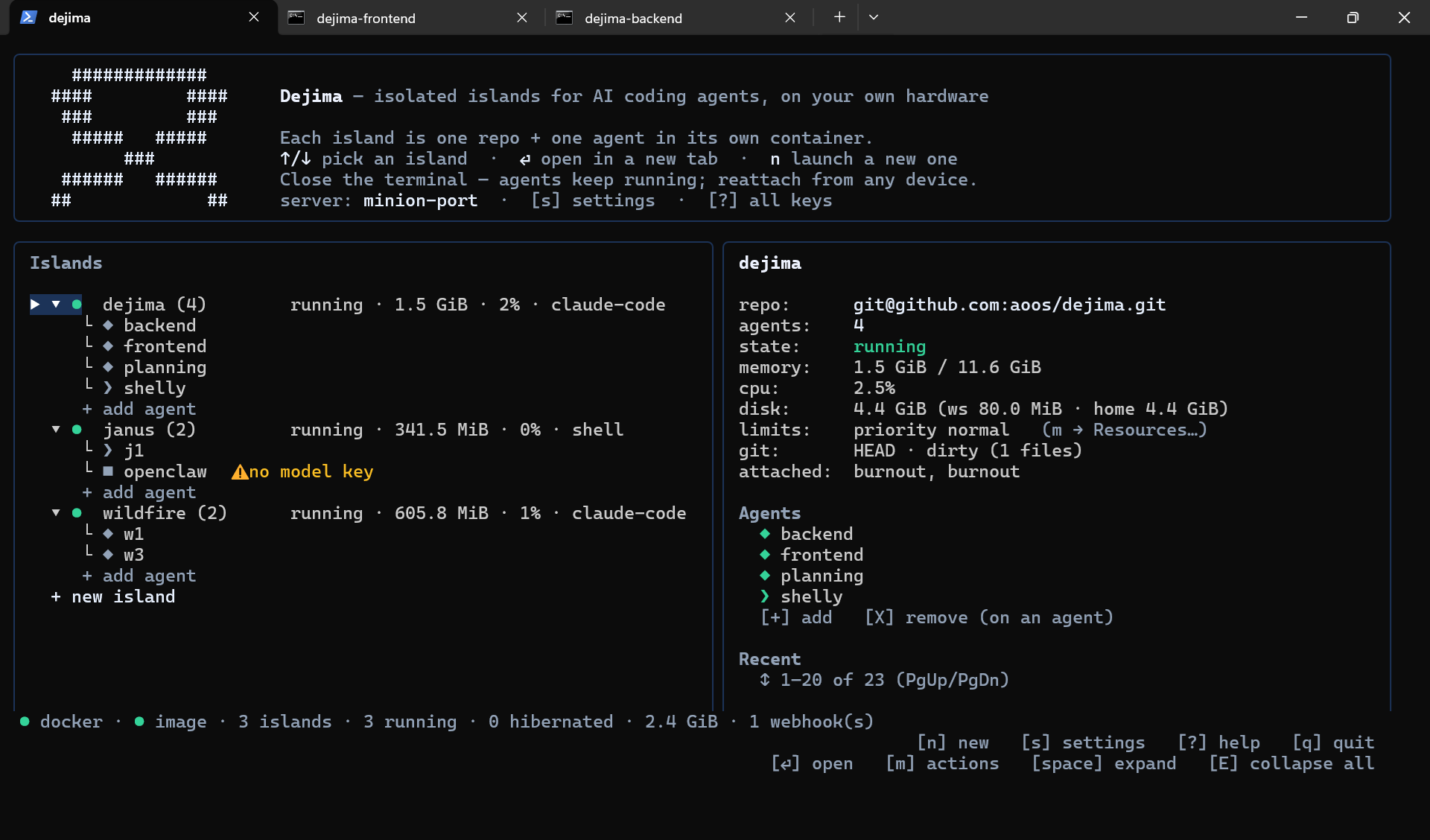
A real capture of the Dejima TUI, driven by your keyboard. Nothing is installed and no server is contacted.
$ █
type dejima and press enter
Every frame in the dejima tab is a real capture of dejima tui --demo, a synthetic fleet that touches no daemon. An attached agent pane is illustrative.
Session resume
Run dejima, hit enter on a project, and every agent in it opens at once, one window each. Close the laptop and they keep working; reattach from any device and the screens are where you left them. Switching projects is another keystroke, not another SSH login.
Secure sandboxing
Rogue agents can't break out. Each project is sealed in its own island, with no reach to your host machine, your files, or your other projects. Run several agents inside one, each on its own git worktree. Host files and MCP servers are gated: deny-all by default, opened one grant at a time. Outbound traffic is attributed to the island that made it and logged, and you can switch any island to an allowlist.
Fleet management
Status, CPU, memory, and token cost per session, for every agent at once. Summon it from inside a session to see what else is running, then drop back in; the agent never notices. Hibernate what's idle, wake what isn't, and jump between projects with a keystroke.
Clipboard and file transfer
A remote shell normally costs you the clipboard and drag-drop. Here Ctrl-V pastes a screenshot straight to the agent, dragging a file onto the window uploads it, and pointing it at any local path does the same. The agent gets the in-island path; dejima cp moves work back out. No scp.
Works with Claude Code, Codex, OpenClaw, or any command you supervise. Point it at frontier APIs, or at open-weights models running on your own box through Ollama.
Still SSHing into tmux to run your agents? Read the full story. Working with others? Onboard a teammate to their own private fleet, without sharing your box.
Every session starts the same way: dejima
Is Dejima right for you?
The hard parts of running agents, already handled
You shouldn't have to become an infrastructure engineer to run agents safely. That usually means wiring up containers, networking, credentials, and session plumbing yourself. Dejima is that layer, already built — and it rests on three things:
- Ease. A few commands install it; run
dejimaand the TUI walks you to a sandboxed agent in minutes. It manages the containers, sessions, git worktrees, and logins so you don't — on your Mac mini, a VPS, or your own cloud VM, same handful of commands. - Security. Every project is walled off from your machine, your files, and your other projects; host access is deny-all, granted explicitly and read-only. The LLM calls go out, but your code, files, and auth never leave your box — auth is your Tailscale identity, not a vendor account. It fits NDA, regulated, and client-confidential work in a way a managed cloud can't.
- Audit. Every privileged crossing is written to a tamper-evident, hash-chained ledger you can read, export, and verify — so you can prove what an agent did, not just hope.
Running agents for a team that has to prove what they did? See Dejima for teams →
Everything you need to run a fleet safely
Past the four above, this is what you get for running agents on your own box.
Brokered host access
Grant an island one host folder, read-only. Everything else stays invisible.
Brokered MCP servers
You curate which MCP servers exist. An island reaches one only once you grant it.
Egress visibility
See every host an island reaches. Put it on an allowlist when you want one.
Audit trail
Every brokered crossing is hash-chained, and verifiable after the fact.
Agent messaging
Agents in an island hand off work to each other with dejima msg.
Cost and token tracking
Spend and token counts per agent, for the session it's in, next to everything else.
Local open-weights models
A curated, hardware-aware catalog. Islands share one Ollama backend on your box.
Scheduled wakes
Wake a hibernated island on a timer and hand its agent the task to run.
Also in the box: headless agents (OpenClaw, Letta, your own loop) alongside terminal ones · lifecycle verbs (hibernate · wake · reset · upgrade · purge) · roles and invites for a shared server · one-key updates that move the client and daemon together · an HTTP/WebSocket API and webhook events to build on.
The isolation of a cloud sandbox, on hardware you own
You're probably weighing Dejima against however you run agents today. Here's where it lands:
| What you need | Dejima | Coder | E2B | Rivet | tmux + SSH | A dev container |
|---|---|---|---|---|---|---|
| Isolated workspace per project | ✓ | ✓ | ✓ | ✓ | ✗ | ✓ |
| Several agents at once, one dashboard | ✓ | $ | ✗ | ✗ | manual | ✗ |
| Agents sandboxed from your host machine | ✓ | ✓ | ✓ | ✓ | ✗ | ~ (from host) |
| Survives disconnect, multi-device | ✓ | ✓ | ✗ | ~ | ✓ | ✗ |
| Runs where you put it — local or your own cloud | ✓ | ✓ | $ | ✓ | ✓ | ✓ |
| Audit log of host-file access | ✓ | ✗ | ✗ | ✗ | ✗ | ✗ |
| Curated MCP servers, brokered & audited | ✓ | ✗ | ✗ | ✗ | ✗ | ✗ |
| Managed local open-weights models (via Ollama) | ✓ | ✗ | ✗ | ✗ | manual | manual |
| Up in minutes, nothing to build | ✓ | ✗ | ~ | ~ | ~ | ✓ |
$ = available only on a paid plan.
One host. Many sealed islands.
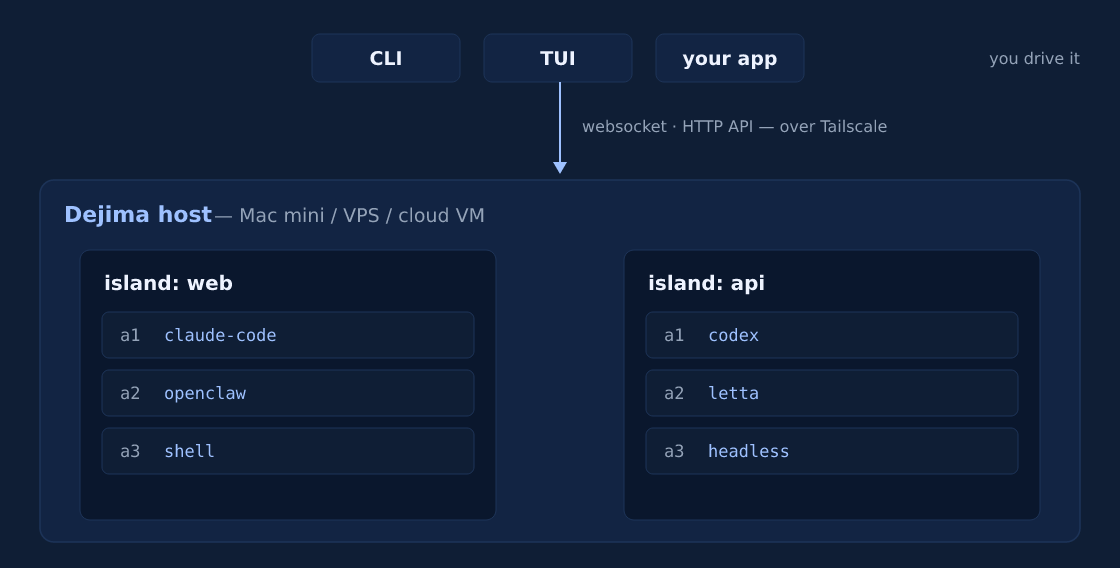
Text version
        CLI · TUI · your app                 (you drive it)
                    │
                    │  websocket + HTTP API · over Tailscale
                    ▼
┌─ Dejima host · Mac mini / VPS / cloud VM ──────────────────────┐
│                                                                │
│   ┌─ island: web ──────────┐    ┌─ island: api ──────────┐     │
│   │ a1  claude-code        │    │ a1  codex              │     │
│   │ a2  codex              │    │ a2  claude-code        │     │
│   │ a3  headless           │    │                        │     │
│   └────────────────────────┘    └────────────────────────┘     │
│                                                                │
│ per island: one container · shared home + credentials          │
│ per agent:  own git worktree · shares the island with its peers│
└────────────────────────────────────────────────────────────────┘
An island is one container holding one or more agents. They share the workspace, credentials, and tool-auth, but each works on its own git worktree — so they collaborate without clobbering each other. Islands can't see each other; that blindness is the security boundary.
Run almost any agent. Each island holds a mix of two kinds:
- Terminal agents you attach to — Claude Code, Codex, or a plain shell (an empty, sandboxed terminal). A host-side bridge wires your session to the agent's tmux inside, so it survives disconnect and multiple devices share one screen.
- Headless agents that run on their own — runtimes like OpenClaw, Letta, and Hermes, or your own SDK loop or worker. Output is captured to
dejima logs.
Both get the same isolation, lifecycle, events, and one-API management — bring your own keys and mix vendors freely.
Guides
Short, practical walkthroughs for getting a fleet running on your own box.
Turn a Mac mini into an AI agent server (free)
Install once, then run Claude Code, Codex, and OpenClaw contained on a mini in the closet.
You're still SSHing into tmux to run your agents?
Where the tmux + SSH setup breaks down, and how to run a contained fleet on the same box.
Common questions
Is Dejima free?
Yes. Dejima is free and open source under Apache 2.0. You run it on hardware you already own, so there's no subscription and no per-second usage bill. You bring your own agents and API keys, and pay only your normal LLM provider costs.
Does my code leave my machine?
No. Your source, your files, and your credentials stay on your own box. The agents' model calls go out to whatever LLM provider you use, but there's no Dejima cloud in the loop and no vendor account holding your work. Auth is your own Tailscale identity.
Which AI coding agents can I run?
Terminal agents you attach to, like Claude Code, Codex, or a plain shell, and headless runtimes like OpenClaw, Letta, and Hermes, or your own SDK loop. You bring your own API keys and can mix vendors freely across islands.
What hardware do I need?
A Mac mini, a Linux server or VPS, a cloud VM in your own account, or just your laptop. Two cores and 4 GB of RAM run a few agents comfortably. The same few commands work on all of them.
How is this different from a cloud agent sandbox?
Services like E2B and Daytona run your agents on their infrastructure and bill by the second. Dejima runs on hardware you own, for free, with persistent sessions you attach to, a dashboard, brokered host access, and an audit log. Your code never leaves your perimeter.
Run a fleet on your own box
On one machine, or on a server you drive from your laptop. A few commands to install, one word to run. Free and open source.
Get started →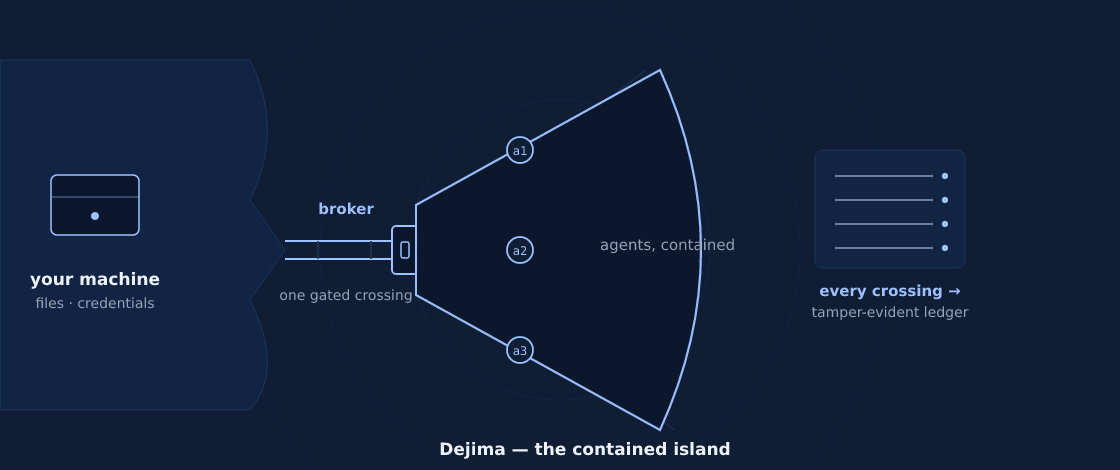
Dejima was an artificial island built in 1636 in Nagasaki Bay to serve as a quarantined trading post for foreigners during Japan's period of isolation — one gated bridge to the mainland, every crossing logged. Your agents run the same way: contained on the island, reaching your machine only through a broker that records what crossed.